
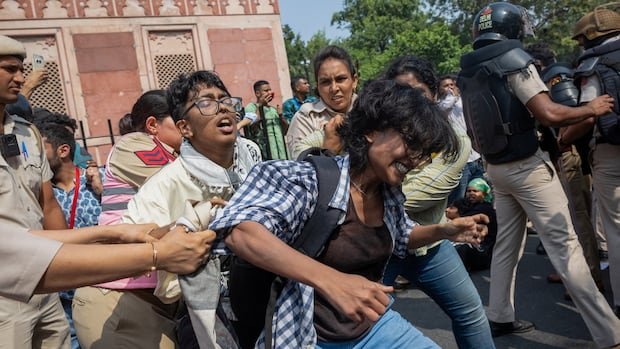
Indian authorities implemented a widespread security crackdown in New Delhi and apprehended numerous demonstrators on Saturday as India’s youth “Cockroach” movement escalated a nationwide campaign against a controversial voter list revision that has sparked discontent with Prime Minister Narendra Modi’s Hindu nationalist government and election authorities.
Police took action to disperse the protest before it started, intercepting protesters en route to Jantar Mantar, the designated protest location in the heart of India’s capital, dispersing some and detaining many others. Several demonstrators were forcefully taken away and transported to temporary holding facilities. Key figures of the Cockroach Janta Party (CJP), opposition lawmakers, and student activists were detained in advance, significantly hampering the protest’s commencement.
The crackdown extended beyond the protest zone, with police conducting checks on buses, cars, and other vehicles at entry points to the capital to locate demonstrators. Jantar Mantar was cordoned off, and anti-riot vehicles with tear gas launchers were positioned along critical routes. Additionally, restrictions on mobile internet access and certain areas of the city added to the challenges confronting protesters.
Authorities mentioned on Friday that the protest request was denied due to a late submission. Sambit Patra, a spokesperson for Modi’s party, dismissed the demonstrators as “anarchic elements” and claimed their efforts had failed.
The significant security measures around the protest site aimed to thwart a burgeoning protest movement that has mobilized numerous young individuals, garnered opposition backing, and increased scrutiny on Modi. These protests coincide with a politically sensitive period, following previous demonstrations by the movement that led to the resignation of Modi’s education minister in July.
Leaders of the movement, Abhijeet Dipke, Saurav Das, and Ashutosh Ranka, were anticipated to lead the protest but were detained upon arrival at Delhi airport from Mumbai on Saturday. The movement criticized the pre-planned police intervention, denouncing it as an attempt to stifle the protest’s leadership before reaching the site.
Despite stringent security measures, some protesters managed to breach police barriers, chanting anti-Modi and election authority slogans before being detained. The police response showcased a strong display of authority in the capital, where dissent has been restrained under Modi’s government through arrests and limitations on public gatherings, raising questions about the space for protests in the democratic nation.
The latest crackdown prompted criticism from opposition leaders, who accused the government of suppressing dissent. The protests revolve around India’s Election Commission’s Special Intensive Revision, which the opposition alleges has disenfranchised millions of eligible voters.
The dispute has become a focal point for opposition parties challenging Modi’s Bharatiya Janata Party, with the protests gaining momentum in the capital and opposition figures intensifying their campaign. Opposition leaders accuse the commission of bias in favor of Modi’s party, while the government and the commission refute these claims.
The youth-driven CJP movement seizes the voter list controversy as an opportunity to expand its advocacy. Originating online in May, the movement gained traction through various forms of protests over exam paper leaks, leading to the education minister’s resignation in July. These developments present a political challenge for Modi midway through his third term, with upcoming state elections in BJP-governed states serving as pivotal tests for the party’s influence.

