
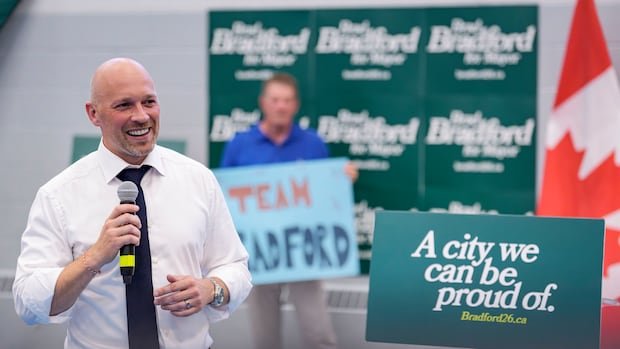
Mayoral contender Brad Bradford’s strategy to combat the housing crisis by reducing a primary revenue stream for Toronto has raised concerns among experts, who emphasize the need for the city to explore additional revenue sources for essential services.
City Councilor Brad Bradford introduced a set of financial proposals this week, which includes a plan to eliminate the Municipal Land Transfer Tax (MLTT) on home sales up to $1.1 million (homes exceeding this value would be exempt on the first $1.1 million of the price).
Bradford’s team projects that this policy change would result in a $300 million loss for the city, creating a gap in the current spending plan amid over a billion dollars in funding shortfalls during recent annual budget discussions.
Advocating for the removal of the tax, Bradford argues that the MLTT, affecting every home sale in Toronto and doubling an existing provincial charge, discourages many potential buyers and exacerbates affordability challenges. He views this move as part of a broader plan to reform the city’s financial operations.
During a news conference on Thursday, Bradford emphasized the need for innovative and visionary approaches, stating, “You want big vision, you want big ideas. It means doing things differently.”
The current structure of Toronto’s land transfer tax varies, with rates ranging from two percent for homes valued between $400,000 and $2 million to 8.6 percent for homes valued over $20 million. The city anticipates that the MLTT will generate $850 million in revenue this year, a decrease from over $1 billion raised in 2021.
Bradford’s team proposes covering the lost revenue by extending the city’s infrastructure project repayment timeline and establishing a public water company that would potentially yield dividends.
Introduced in 2008, Toronto’s land transfer tax has contributed billions to the city’s finances, predominantly supporting basic services through the operating budget.
The president of the Toronto Regional Real Estate Board highlighted that the city’s land transfer tax adds approximately $36,000 in upfront costs to the average home purchase in Toronto, which stands slightly above a million dollars. He stressed that this amount could deter many prospective homebuyers from entering the market.
York University public policy professor Zac Spicer noted that Bradford’s plan involves trade-offs. While the land transfer tax has been a significant revenue generator, it has had a tangible impact on Toronto’s housing market dynamics.
Spicer indicated that Bradford’s proposal could prompt discussions during the election on Toronto’s broader financial requirements. He underscored the limited revenue-raising options available to the city under current legislation, restricted mainly to property taxes, user fees, and provincial transfers.
Former city officials have cautioned about the city’s excessive reliance on MLTT revenues. Concerns have been raised over the years regarding the volatility of this revenue source, heavily tied to the fluctuations in Toronto’s real estate market.
Progressive city councillor Joe Mihevc emphasized the importance of retaining multiple revenue tools to address Toronto’s financial challenges effectively, cautioning against giving up the key revenue source provided by the province.
University of Toronto municipal finance professor Enid Slack highlighted the political challenges associated with property tax increases as an alternative revenue source. She emphasized the visibility of property taxes to residents compared to other taxes, making hikes a tough sell politically.
Whoever wins the mayoral election may face similar challenges in persuading higher levels of government to provide additional revenue tools to the city, a task that has proven difficult for past mayors.
Mayor Olivia Chow’s unsuccessful attempt to secure permission for a city sales tax underscores the ongoing struggle for municipalities to access diversified revenue streams from provincial and federal governments.
In conclusion, the debate around Toronto’s financial future is likely to intensify, necessitating a comprehensive approach to revenue generation to sustain essential services and infrastructure development.

