
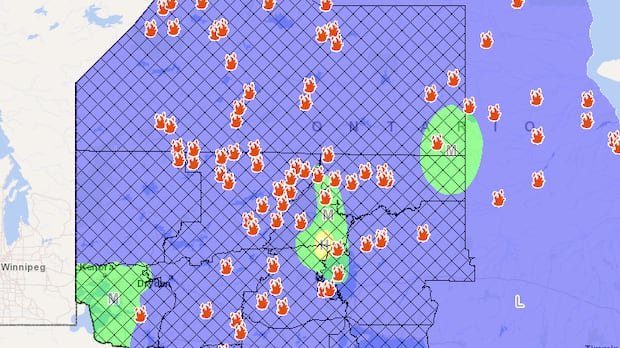
In northwestern Ontario, the latest report from Ontario’s Aviation, Forest Fire and Emergency Services (AFFES) reveals that there are currently 85 active wildfires. Among these, seven are uncontrolled, six are being managed, nine are under control, and the rest are being monitored.
As of Saturday evening, no new fires have been reported in the northwest region since the previous update on Friday. The province noted that cooler temperatures and expected precipitation on Saturday could assist in reducing the severity of some major fires in the area.
The forest fire risk in northwestern Ontario is mostly low, with pockets of moderate hazard in specific areas such as Kenora, Marten Falls First Nation, and the Thunder Bay fire management district north of Lake Nipigon.
Notable fires in the region include the Rinker Complex, which comprises Thunder Bay 36, Dryden 34, and Dryden 35. These fires collectively cover a vast area and remain uncontrolled, with evacuation orders in place. Similarly, the Atikokan Cluster, consisting of Fort Frances 13, 14, and 15, faces varying degrees of control status.
Approximately 829 individuals are still displaced due to the wildfires in Ontario, while around 2,000 evacuees from northwestern Ontario have returned home. The ministry of Emergency Preparedness and Response has conducted numerous coordination calls with various stakeholders to manage the situation effectively.
Evacuation alerts are active for Fort Frances 39 and Minnesota’s “Thumb Fire,” urging residents to be prepared for potential evacuations. Highway closures are in place due to wildfire activity, and Canada Post has suspended mail delivery in affected communities.
In the northeast region, eight new fires have been confirmed, adding to the total of 47 active wildfires. The ministry has allocated additional resources and funding to combat the fires, including the purchase of new firefighting equipment and the deployment of personnel to aid in the ongoing efforts.

