
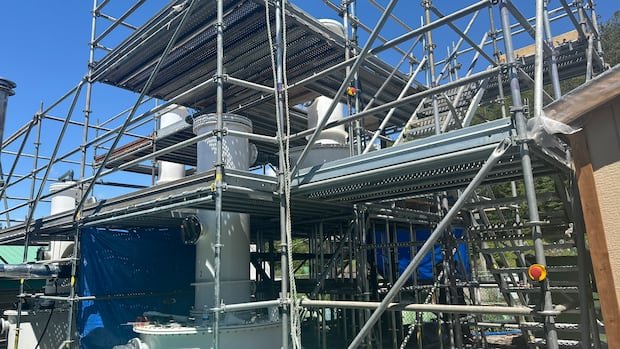
A startup in Nova Scotia is currently conducting tests on a new method to capture and store more carbon in the ocean through a pilot facility. The ocean has been absorbing approximately 30% of all human-generated carbon emissions since the 1980s. pHathom, the company behind this initiative, aims to enhance this natural process by capturing carbon dioxide and transforming it into a form suitable for long-term storage in the ocean.
The testing of this approach is taking place at the Huntsman Marine Science Centre in St. Andrews, N.B. Kimberly Gilbert, the co-founder and CEO of pHathom, emphasized the importance of demonstrating the safety and effectiveness of the method at a local level before scaling up. The process involves replicating the natural carbon absorption process that occurs when raindrops interact with alkaline rocks, converting carbon dioxide into bicarbonate that can be stored in the ocean for thousands of years.
pHathom’s method involves exposing seawater to the emissions of a biomass power plant in a controlled environment to convert carbon dioxide into bicarbonate using limestone particles. This treated water is then reintroduced into the ocean with the same pH level as regular seawater. Other companies in Nova Scotia are also exploring similar carbon removal approaches known as alkalinity enhancement.
The pilot phase aims to capture 0.1 tonnes of carbon dioxide per day, with plans to scale up operations in Nova Scotia next year. The successful implementation of such technologies is crucial for addressing the global climate crisis. Despite challenges such as energy consumption and scalability, researchers and companies are optimistic about the potential of carbon removal technologies to mitigate climate change impacts. pHathom remains hopeful that their technology will be instrumental in global efforts to combat climate change when the time comes for action.

