
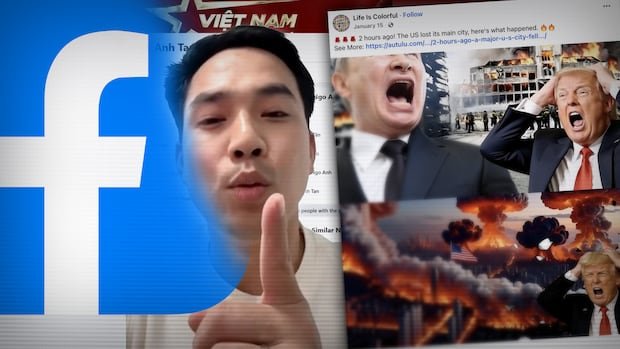
At an early 2026 corporate event filled with dancing mascots and pyrotechnics, the CEO of HTV Network, Ngo Anh Tan, proudly displayed a Vietnamese sign reading “Doanh Thu Đột Phá,” translated as “Record Revenue.” The occasion marked a milestone for HTV, which had grown from its inception as an “international media company” focused on authoritative journalism to now employing over 100 individuals, according to a Vietnamese job posting.
However, an investigation by CBC’s visual investigations unit and Radio-Canada’s Décrypteurs uncovered a stark contrast between HTV’s public image and its true operations. The company, led by Ngo and his team, was found to be orchestrating an AI-generated empire from Hanoi, Vietnam, disseminating fake news and sensationalized stories worldwide. These stories ranged from false claims like Elon Musk banning Teslas in Canada to exploiting tragic events for clickbait purposes.
The investigation revealed nearly 200 Facebook pages with over 55 million followers collectively sharing links to around 50 HTV-affiliated websites. These websites monetized their traffic by displaying ads alongside misleading political and religious content, raising concerns about the spread of misinformation.
Experts, like Fenwick McKelvey from Concordia University, condemned HTV’s deceptive practices as harmful and manipulative. The company’s association with a legitimate Vietnamese broadcaster further complicated efforts to track its activities.
HTV’s revenue generation model involved mass-producing AI-generated content, sharing it on various Facebook pages, and redirecting users to websites filled with advertisements. The analysis highlighted the monetization of both the websites and Facebook pages, indicating a deliberate scheme to profit from misinformation.
Despite inquiries, Ngo denied knowledge of HTV’s online presence, leading to the swift removal of the company’s website and digital traces connecting him to the operation. The lack of accountability in platforms like Facebook, which incentivize low-quality and engaging content, was also highlighted as a contributing factor to the proliferation of such deceptive practices.
By utilizing corporate documents, investigative reporting, and specialized software, the CBC/Radio-Canada team traced the network’s activities back to HTV Network. The initial lead came from a report by the Media Ecosystem Observatory, shedding light on Facebook pages and websites managed from Vietnam.
Further investigation tied a unique email address, “kolax9843,” to multiple low-quality websites linked to HTV Network. The interconnected web of misinformation extended to verified Facebook pages with substantial followings, such as “Danny Fernandes,” which amplified false political narratives for engagement.
Images and records pointed to Ngo Anh Tan’s involvement in the network, with corporate filings aligning with his personal details. Despite attempts to distance himself from HTV’s operations, evidence suggested his direct ties to the company and its deceptive practices.
The uncovering of HTV’s operations underscored the impact of AI-driven content production and the lax enforcement of platform policies by companies like Meta. The prevalence of such misleading content poses a significant threat to public discourse and highlights the need for greater oversight and accountability in the digital space.

