
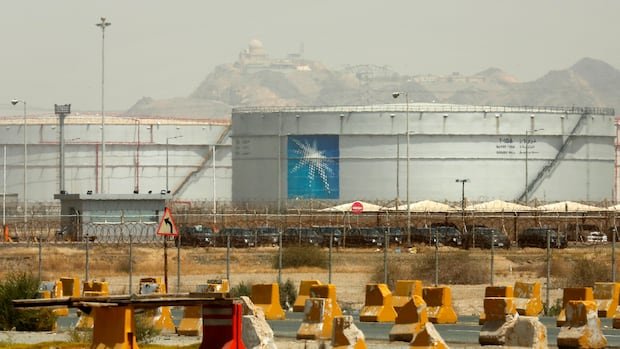
An administrative facility owned by Saudi Aramco, the state-run oil company of Saudi Arabia, located in Dhahran’s eastern city, was targeted in an attack, resulting in a contained fire, as per a statement released by the Energy Ministry on Wednesday. The clash between Yemen’s Iran-backed Houthi rebels and the kingdom has escalated.
The ministry confirmed that officials promptly addressed the situation on Tuesday night and implemented necessary precautions, mentioning that no casualties occurred. Sources familiar with the incident revealed that the Aramco headquarters building was ablaze. The Dhahran complex serves as a significant operations hub for Aramco, overseeing a wide array of onshore and offshore oil installations, pipelines, refineries, and export terminals.
The Houthi group claimed responsibility for launching ballistic missiles, cruise missiles, and drones at Saudi Aramco facilities in Dhahran, King Khalid International Airport in Riyadh, and an Aramco refinery in Riyadh. The attacks were not timestamped. In response to Saudi Arabia’s support for government forces in Yemen’s ongoing civil conflict, the Houthi rebels have been targeting key Saudi locations with missiles and drones for a week. Riyadh’s international airport has faced four strikes, including one on Saturday that resulted in 13 casualties, leading to the cancellation of several flights to Saudi Arabia.
Issuing a broad warning, the Houthis urged the evacuation of airports and oil installations by “international shipping companies,” civilians, and workers, declaring these sites as legitimate military targets.
Following a deadly strike at the airport, the Saudi-led coalition reported thwarting a Houthi-launched ballistic missile aimed at Riyadh on Wednesday, causing audible blasts in the capital. Saudi Civil Defence disclosed that four individuals sustained injuries in Riyadh due to fragments from two intercepted Houthi missiles. The debris caused minor damage to 15 residences, with two women, a man, and a child among the injured.
Al-Masirah TV, a Houthi-controlled channel, reported that the coalition targeted the Yemen Petroleum Company’s Sabah central station, a fuel depot near Sanaa’s outskirts. The coalition stated that it launched an operation on Tuesday evening to neutralize Houthi threats against Saudi Arabia, Yemen, and international maritime routes.
The ongoing conflict has impeded Saudi Crown Prince Mohammed bin Salman’s ambitions to diversify the kingdom’s economy and reduce its oil dependence. The Yemen crisis has reignited as a fallout from the broader U.S.-Iran conflict initiated by a U.S.-Israeli strike on Iran on February 28.
Saudi Arabia reinitiated military efforts in Yemen to bolster the internationally recognized government and counter the Houthis’ recent territorial advancements. The Bab el-Mandeb Strait, crucial for global energy supplies, has gained strategic importance since Iran’s blockade of the Strait of Hormuz in February.
The UN World Food Program (WFP) raised concerns over the humanitarian situation in Taiz, indicating a halt in life-saving aid to over 600,000 people, including 200,000 women and children. Hospitals in Yemen are struggling to manage the surge in war-related casualties as clashes intensify on multiple fronts.
Despite seeking broader support for its campaign against the Houthis and to defend against missile and drone assaults, Saudi Arabia’s attempts to involve the U.S. directly in the conflict have been unsuccessful. In 2015, Saudi Arabia intervened in Yemen’s civil war to back the government following the Houthi takeover of Sanaa, resulting in a protracted humanitarian crisis until a 2022 truce brokered by the UN, which was disrupted by recent hostilities.

