
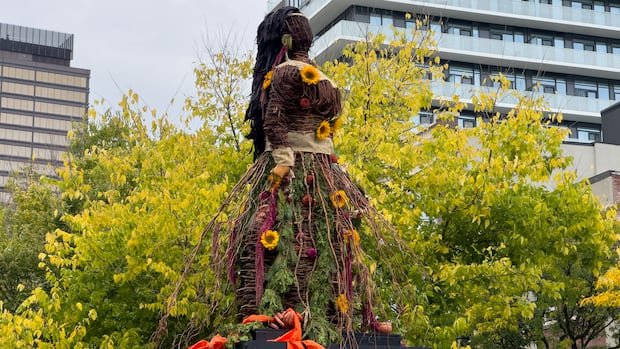
An art exhibit at Gore Park in Hamilton is prompting reflection on the legacy of Canada’s first prime minister and reclaiming the space where his statue once stood. The installation, titled “Right to Repossess,” by the Indigenous production company Bawaadan Collective, features a representation of Mother Earth standing on Sir John A. Macdonald’s former pedestal.
The exhibit was unveiled in honor of the National Day for Truth and Reconciliation. The statue of Macdonald was removed in August 2021 by protesters due to his involvement in establishing Canada’s residential school system, which forcibly separated around 150,000 Indigenous children from their families.
Members of the collective and the public gathered at an event promoted by the City of Hamilton to witness the unveiling of the exhibit. The event’s timing, 2:15 p.m., marked the discovery of potential unmarked graves at the former Kamloops Indian Residential School site in 2021.
Shyann Jenkins, a performer from St. Catharines, Ontario, danced a jingle dress dance at Gore Park, aiming to bring healing to those present. Following the dance, orange paper hearts were distributed for attendees to write messages of commitment to residential school survivors and Indigenous communities, which were then hung around the statue’s pedestal.
The Bawaadan Collective’s first public art installation, “Right to Repossess,” is made from natural materials like willow, cedar pine, and corn husk. The artists expressed their hope that the exhibit would aid in the healing process and foster growth within Indigenous communities.
The exhibit invites viewers to reconsider their perspectives on Macdonald and the impacts of residential schools. It will be taken down soon, with hopes of finding a permanent home in the city. The City of Hamilton is reviewing its monuments and landmarks, including Macdonald’s statue, to better honor Indigenous communities in line with its Urban Indigenous Strategy.
Residential schools, operated by the government and churches from 1857 to 1996, had a devastating impact on Indigenous communities, leading to thousands of deaths and widespread abuse. The Truth and Reconciliation Commission’s report highlighted these atrocities and issued 94 calls to action, with only a fraction implemented to date.
The event at Gore Park was part of several activities across Hamilton and Canada commemorating the National Day for Truth and Reconciliation. Attendees engaged in ceremonies, speeches, and performances to honor the survivors and victims of the residential school system.
For emotional and crisis support related to Indian Residential Schools, a national crisis line is available at 1-866-925-4419. Additionally, mental health counseling and crisis support are accessible 24/7 through the Hope for Wellness hotline at 1-855-242-3310 or online chat.

