
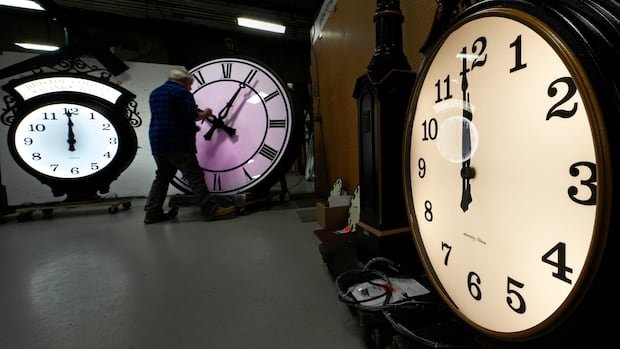
For over half a century, humanity has utilized “leap seconds” to ensure synchronization between our timekeeping devices and the Earth’s rotation. On Thursday, an international timekeeping body in France is set to eliminate leap seconds, allowing clocks to gradually drift out of sync by a full hour, a process that could take centuries or even millennia.
The precise atomic time, established in the 1950s using atomic vibrations, slightly deviates from solar time, based on the sun’s position relative to a specific Earth location, due to the gradual slowing of the planet’s rotation. The introduction of leap seconds in 1972 aimed to rectify this discrepancy, with an immediate addition of ten seconds. Subsequently, the International Earth Rotation and Reference Systems Service has overseen the adjustment process, adding leap seconds 27 times, most recently in 2016.
Without these periodic corrections, there would be no noticeable impact in our lifetimes. However, prolonged neglect could lead to significant disruptions, with daylight and darkness occurring at unconventional hours. Just as leap years maintain the Gregorian calendar’s alignment with the seasons, leap seconds ensure accurate time tracking.
The decision to phase out leap seconds comes as managing them becomes increasingly challenging for systems reliant on precise timekeeping, as stated by Scott Beattie from the National Research Council of Canada’s Metrology Research Centre. The variation in implementing leap seconds across networks poses risks of system failures, exemplified by previous incidents like Reddit and LinkedIn crashes in 2012 and brief Cloudflare outages in 2016.
In a noteworthy development, the Earth’s rotation has accelerated in recent years, raising the prospect of a “negative leap second” where a second would be subtracted. This adjustment could have adverse effects on software systems, according to tech giant Meta. The proposed solution, effective from May 2027, involves accumulating extra seconds to a total of 3,600 before making the necessary clock adjustments, thus postponing the issue for future generations.
While some experts support this approach, others like Paul Delaney from York University express reservations, emphasizing the complexities of managing time in a technology-driven economy. Samantha Lawler, an astronomy professor at the University of Regina, highlights the challenges in accounting for variations in Earth’s rotation speed, acknowledging that achieving absolute precision in timekeeping is an ongoing struggle.
Embracing imperfections in time tracking systems, Lawler suggests that humanity must acknowledge the inherent difficulties in aligning our clocks with the natural world.

