
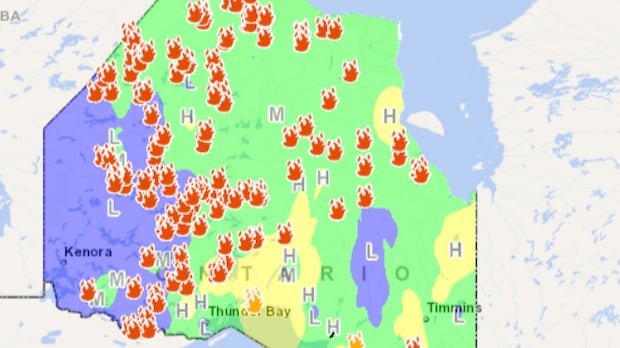
As per the most recent report from Ontario’s Aviation, Forest Fire and Emergency Services (AFFES) released on Friday night, there are currently 87 active wildfires in northwestern Ontario. Out of these, 10 are not contained, six are being monitored, eight are under control, and the rest are being observed.
Additionally, two new fires were confirmed in the northwest region on Friday evening. Nipigon 99 (NIP099) is situated east of Pays Plat, around 3 kilometers northeast of Highway 17 and 5.5 kilometers north of Rossport, covering 0.1 hectares and not under control. Nipigon 100 (NIP100) is located approximately 10.5 kilometers north of Highway 17 in Pays Plat and 2 kilometers northeast of West Fox Lake, also covering 0.1 hectares and not under control.
While the forest fire hazard is mainly low to moderate across most of northwestern Ontario, areas of high hazard are prevalent in the southwestern parts, including Thunder Bay and Kenora districts.
Notable Fires in the Region
- The Rinker Complex: Comprising Thunder Bay 36, Dryden 34, and Dryden 35, this remains a major firefighting operation in the region. Thunder Bay 36 spans 301,240 hectares, while Dryden 34 covers 45,800 hectares, and Dryden 35 is at 30,201 hectares. All three fires are still uncontrolled, with evacuation orders in place. Despite low fire activity, dry and gusty weather conditions on Thursday led to increased fire behavior on Friday.
- Atikokan Cluster: Including Fort Frances 13, 14, and 15, these fires cover 25,279, 51,768, and 42,273 hectares, respectively. While Fort Frances 13 is being observed, Fort Frances 14 and 15 are not under control. Smoke levels increased on Friday due to sunny skies, low humidity, and haze from fires on the Pacific coast and in the United States.
Approximately 829 Individuals Displaced
As of Friday, around 829 individuals are displaced due to the wildfires in Ontario, as reported by the Ministry of Emergency Preparedness and Response. Over 2,000 evacuees from across northwestern Ontario have been able to return home.
The ministry has conducted over 110 coordination calls with various stakeholders, including First Nation chiefs, community leaders, emergency partners, municipalities, and the federal government, according to Jill Dunlop, Ontario’s Minister of Emergency Preparedness and Response.
Evacuation and Implementation Orders
Two new evacuation alerts are active for Fort Frances 39 and Minnesota’s “Thumb Fire.” The Dryden Fort Frances Atikokan District has issued an evacuation alert due to the evolving fire situation.
People in the vicinity of the fires are advised to prepare for potential evacuation on short notice. Evacuation orders and alerts remain in effect for several areas near ongoing fires.
For safety, residents under evacuation orders must leave the area, while those under evacuation alerts should be ready to evacuate promptly.
The ministry is conducting assessment flights to document property damage, and affected property owners can seek assistance by contacting 211 for further information and support.
In addition, the ministry is collaborating with Namaygoosisagagun First Nation to restore access routes and working with various stakeholders to assess damages and facilitate their return.
Northwestern and a portion of northeastern Ontario are under a restricted fire zone, prohibiting open-air burning, including campfires. Notice to Air Missions (NOTAMs) have been issued for designated areas.
Updates have been made to the implementation order for active fires in the Thunder Bay–Ignace District, removing certain previously specified areas.
Highway Closures and Safety Measures
Several roads are closed due to wildfire activity, as indicated on the province’s interactive highway map. The Ontario Provincial Police (OPP) advise the public to stay away from affected areas, follow evacuation orders, avoid non-essential travel, and assist emergency responders by maintaining clear roadways.
Mail delivery has been suspended in select communities due to wildfire risks. New fires have been reported in the northeast region, with varying levels of containment and observation.
Efforts Against Wildfires
The ministry is allocating $650 million for new firefighting resources, including waterbombers and helicopters. Additional permanent fire personnel positions have been created, with enhanced compensation for staff.
An

