
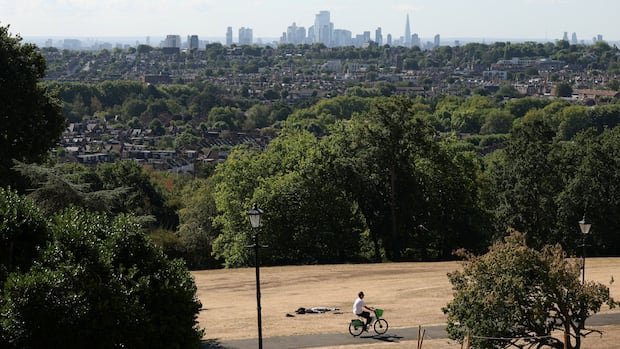
In the midst of a heatwave and severe drought in Britain this summer, Divya Hariramani was trimming a plum tree in south London when she observed an issue with one of its branches. The branch was starting to detach from the tree, a result of the tree’s stress due to the hot weather. Hariramani, who shares her experiences documenting fruit trees and their caretakers in London on a social media account called Fruity Walks, mentioned that the lack of water supply to tree parts can lead to such situations.
While London is often recognized for its stone architecture, the city is also famous for its extensive urban forest, considered one of the largest globally. However, this year has been challenging for the lush canopy as consecutive heatwaves and minimal rainfall have strained plants and wildlife, with a bleak outlook for the city’s eight million trees.
According to a recent report from Royal Botanic Gardens Kew, which predicts the vulnerability of London’s urban forest, climate change could endanger around 73% of the city’s trees by the end of the century. The report highlighted that a significant portion of London’s public trees are already at risk due to climate conditions, with a notable percentage categorized as “vulnerable.”
These challenges are not just future projections, as evidenced by the loss of 400 trees at Kew Gardens in 2022 due to extreme heat and drought. The gardens left a red oak skeleton as a symbol of the impact of climate change on London’s trees. The situation intensified during Climate Action Week in June, coinciding with multiple heatwaves and a severe drought across England and Wales, resulting in the driest July on record in Britain.
The adverse effects of the weather were evident, with farmers facing crop losses, potential food shortages, and wildfires prompting emergency alerts. In urban areas, park grass turned yellow, and trees exhibited signs of distress, such as drooping leaves and premature leaf shedding. The challenges of climate change forced Hariramani to cancel a group walk planned during Climate Action Week, highlighting the urgency of addressing environmental concerns.
As London’s climate shifts towards warmer conditions, botanists are considering planting different tree species better suited to the changing environment. Experts suggest that by 2050, London’s climate may resemble that of present-day Barcelona, prompting the exploration of tree varieties resilient to both heat and wet winters.
Paul Wood, a renowned author focusing on London’s trees, expressed concerns about the future of the city’s green spaces amidst extreme weather conditions. He emphasized the historical and ecological significance of London’s ancient woodlands and tree population, noting the irreplaceable value they hold.
In conclusion, London’s urban forest faces unprecedented challenges amid changing climate patterns, necessitating proactive measures to safeguard its diverse tree species and ecological heritage.

