
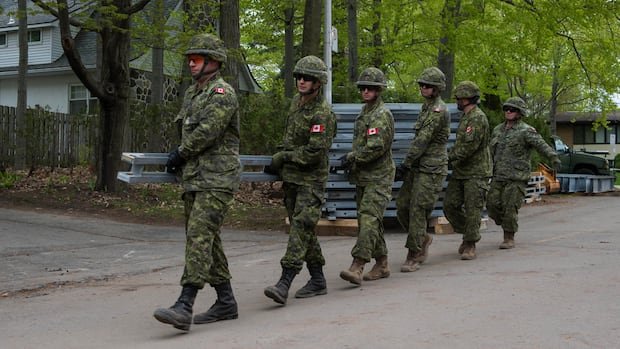
Canada’s military underwent a significant structural transformation on Thursday, transitioning from geographically-based divisions to ones centered around specific functions. Canadian Forces Base (CFB) Edmonton hosted a ceremony to establish the 1st Canadian Division, which will be at the forefront of large-scale combat operations and crisis responses. Headquartered in Edmonton, this “manoeuvre division” will consolidate various capabilities such as tanks, artillery, infantry, paratroopers, and engineers to enhance rapid deployment and sustained operations.
Maj.-Gen. Wade Rutland, the commander of the new division, emphasized the importance of this change in enhancing the army’s agility, lethality, and relevance in defending Canada. Rutland highlighted the evolving threat landscape, pointing to the resurgence of large-scale combat operations globally. The establishment of a war-fighting division is seen as crucial in aligning the army with future combat scenarios where integration of air, cyber, and space capabilities is essential.
The restructuring efforts, led by Lt.-Gen. Michael Wright under the Inflection Point plan, aim to modernize the army’s structure. In addition to the manoeuvre division, the army is forming a support division based in Kingston, Ontario, and a “defence of Canada” division in Montreal, known as the 2nd Canadian Division. The historic 3rd Canadian Division will be retired to the supplementary Order of Battle, reallocating its resources and personnel to support the new divisions.
The 1st Canadian Division, with a storied history dating back to World War I, will oversee multiple brigade groups and regiments across different locations in Canada. This restructuring signifies a significant step in preparing the Canadian military for future combat scenarios, building on its legacy of service and leadership in times of conflict.

