
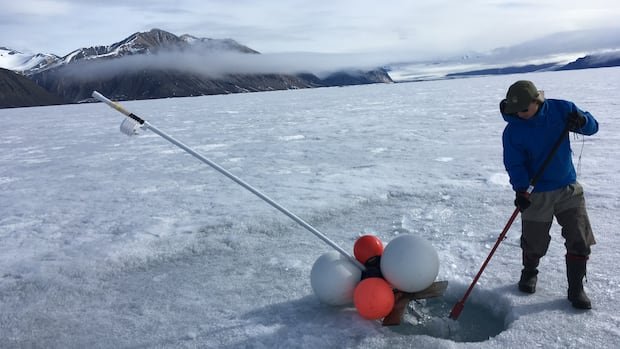
Canada has lost its last epishelf lake, a unique ecosystem consisting of freshwater floating on saltwater. The disappearance of the Milne Fiord epishelf lake on Ellesmere Island in Nunavut marks the end of a 4000-year era, according to a recent study published in Scientific Reports. This loss highlights the impact of climate change on the Arctic region.
The lake’s formation was due to the damming effect of the Milne Ice Shelf at the mouth of Milne Fiord, preventing freshwater from mixing with seawater. The freshwater layer, 18 meters deep when first measured in 1983, was protected by a layer of ice, creating a distinct ecosystem.
The lake supported two unique ecosystems within its layers, with little overlap between the freshwater and saltwater communities. The disappearance of the lake following the collapse of the Milne Ice Shelf in 2020 led to the rapid mixing of freshwater and seawater, resulting in the demise of organisms adapted to the lake’s conditions.
Researchers discovered diverse microbial life in the lake, including bacteria, eukaryotic microbes, and viruses, some of which were previously unreported in the Arctic. The lake also nurtured a thriving ecosystem in the channel where freshwater flowed out, sustaining sea anemones, scallops, and sea stars in complete darkness.
While epishelf lakes no longer exist in Canada, a few remain in Greenland and Antarctica. Scientists warn that these unique ecosystems are at risk due to ongoing environmental changes, underscoring the irreversible loss of the Canadian epishelf lake and the need for conservation efforts to protect similar ecosystems worldwide.

