
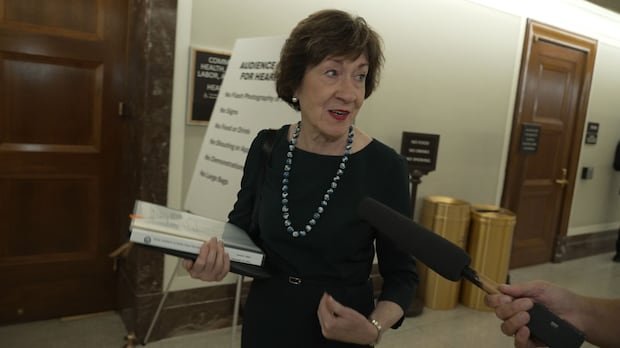
A veteran Republican senator representing a border state has cautioned Prime Minister Mark Carney about enhancing Canada’s economic and political connections with the European Union. Senator Susan Collins of Maine, who is currently campaigning for re-election in a state heavily reliant on cross-border trade, expressed disappointment over Canada’s pivot towards the EU in response to U.S. President Donald Trump’s tariffs.
During an interview with CBC News correspondent Katie Simpson at the U.S. Capitol, Collins emphasized the importance of rebuilding the once-strong relationship between the U.S. and Canada. This warning comes in the wake of European Commission President Ursula von der Leyen’s invitation to Canada to potentially become an “associate member” of the EU, an undefined status within the EU framework.
President Trump, in response to the EU’s proposal, criticized the notion, dubbing it “laughable” and issuing a warning of possible retaliatory measures against Europe if perceived as hostile. Collins expressed concerns that deepening ties between Canada and Europe could hinder negotiations between the Carney administration and the Trump government to resolve the ongoing trade dispute.
Highlighting the significance of trade relations with Canada to her state, Collins opposed Trump’s tariff policies and played a role in securing exemptions for certain Canadian imports, such as cement and road salt. The senator’s remarks reflect a broader unease within some Republican circles in Congress regarding Trump’s trade strategies, particularly as the midterm elections draw closer.
On the Democratic side, Senator Chris Coons of Delaware acknowledged the challenges of reversing Trump’s trade policies but emphasized the potential for improved relations with Canada under a Democratic-led Congress. Coons revealed plans for a bipartisan congressional trip to Canada to convey solidarity and address concerns over the trade dispute.
Democrats have also introduced legislation seeking to repeal and refund tariffs imposed by the Trump administration, including those affecting Canadian products. However, the likelihood of such bills passing into law remains uncertain given Trump’s veto power and the need for a significant majority in Congress.
The ongoing debate over trade policies underscores the complex dynamics shaping international relations and the implications for key stakeholders involved.

