
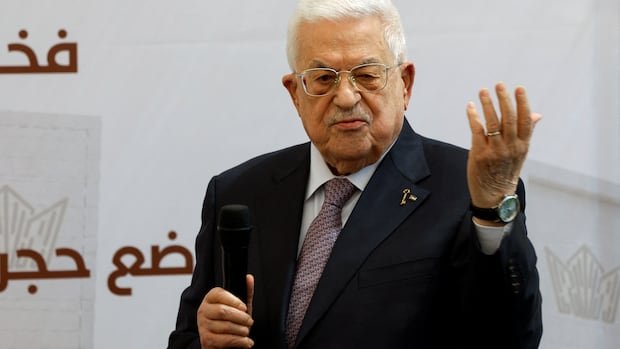
The Trump administration has rejected visas for a senior Palestinian delegation to participate in the annual gathering of global leaders at the United Nations for the second consecutive year. The U.S. State Department announced on Wednesday that Palestinian officials, including President Mahmoud Abbas, did not uphold their commitments from previous agreements aimed at achieving peace with Israel. The department stated that the Palestinian Authority persisted in legal actions against Israel at the International Court of Justice and the International Criminal Court (ICC), as well as continued to provide allowances to families of prisoners convicted of assaults on Israelis. Additionally, individuals associated with the Palestine Liberation Organization (PLO) were mentioned.
The U.S. State Department expressed that due to the failure of Palestinian officials to reform as agreed with the United States and their continuous actions that undermine peace prospects, the U.S. would enforce sanctions denying visas to PLO members and Palestinian Authority officials in compliance with existing U.S. legislation.
Palestinian representatives argue that decades of negotiations facilitated by the U.S. have not brought an end to Israeli occupation or secured an independent Palestinian state. Under a 1947 UN “headquarters agreement,” the U.S. generally grants access to foreign diplomats attending the UN in New York. However, the U.S. has the authority to refuse visas for reasons related to security, extremism, and foreign policy.
This decision is the latest in a series of visa restrictions imposed by the Trump administration, underscoring the close relationship between the U.S. and Israel. The move also reflects the U.S. government’s efforts to discredit the ICC, alleging biased prosecution of U.S. and Israeli military personnel for alleged offenses in Afghanistan, Iraq, and Gaza. Notably, both Israel and the U.S. are not members of the international tribunal.
The denial of visas comes amid ongoing tensions between Israel and Palestine following the 2023 attacks by Hamas, which led to international criticism of Israel’s actions in Gaza. While a fragile ceasefire was established in October, Israel has continued to conduct military operations in the Palestinian territory.
On the domestic front, the Trump administration has taken measures such as attempting to expel foreign pro-Palestinian demonstrators, threatening funding cuts to universities over protests, and implementing social media screening for immigrants.
The Palestinian Authority, serving as the representation of the Palestinian people at the UN, operates under the title of the State of Palestine within the United Nations, holding observer state status similar to the Vatican and lacking voting rights in the General Assembly.
Despite the visa refusals, Palestinian diplomats accredited to the United Nations will represent the Palestinians at the upcoming high-level UN General Assembly meeting. Last year, President Abbas participated via video link.

