
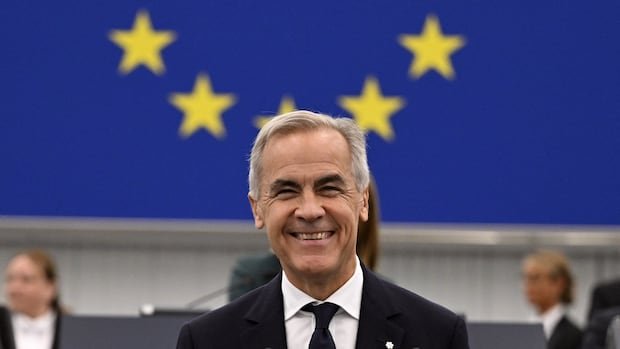
Prime Minister Mark Carney and European Commission President Ursula von der Leyen delivered speeches this week outlining a new alliance between Canada and the EU. However, many aspects of the partnership are still under discussion and require further clarification.
Carney has repeatedly emphasized that Canada does not intend to join the EU as a full member. Nonetheless, during his address to the European Parliament in France, he expressed openness to von der Leyen’s proposal for Canada to become the EU’s inaugural “associate member” within the 27-nation bloc.
The concept of an “associate member” lacks an established legal framework, although similar arrangements have been considered in the past for other countries like Ukraine. A senior Canadian official, speaking anonymously to CBC News, mentioned that the designation of “associate member” is one of several options being explored, with Canada not originating the suggestion.
While details are still forthcoming, von der Leyen’s speech highlighted the EU’s aim to elevate its partnership with Canada to the highest possible level. The discussions encompass various areas such as manufacturing, technology, defense, the Arctic, energy, and security.
Carney outlined specific aspects of the envisioned partnership, including collaboration on critical minerals, defense capabilities, artificial intelligence, energy security, and educational initiatives like Erasmus+. The proposal also involves cooperation in research and innovation, digital trade, financial services integration, and AI regulation.
Although Canada and the EU already have agreements in place, such as the Comprehensive Economic and Trade Agreement (CETA), Strategic Partnership Agreement, and Security and Defense Partnership, the potential alliance seeks to deepen and broaden their cooperation without aiming to rival other global powers.
Concrete details of the partnership are expected to be discussed further at a Canada-EU summit scheduled for late October in Montreal. However, uncertainties remain regarding the agreement’s name, Canada’s commitments, potential changes in mobility beyond student exchanges, and the necessity of approval from EU member states and the Canadian Parliament.
Carney confirmed that any alliance structure with the EU would undergo parliamentary scrutiny and voting. Some EU diplomats have raised concerns about the proposal’s lack of prior consultation with member states. Von der Leyen’s proposal does not involve formalizing the “associate member” status in EU treaties, which would necessitate unanimous approval from all 27 countries and domestic ratification.
Even the long-standing Canada-EU free trade agreement is not uniformly implemented across all EU member states, underscoring the complexities of international agreements within the bloc.

