
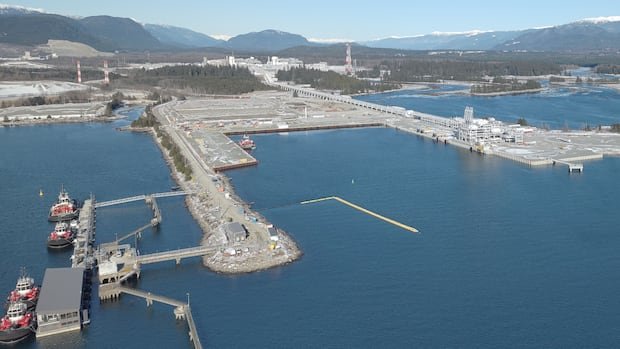
A $50,000 administrative penalty has been imposed on the company overseeing a significant LNG export terminal on British Columbia’s North Coast due to underwater noise issues during the construction of a tug terminal three years ago.
The tug terminal was a component of Phase 1 of LNG Canada’s natural gas liquefaction and export terminal in Kitimat, which commenced operations last year.
The Environmental Assessment Office (EAO) of British Columbia stated in a decision dated Sept. 17 that LNG Canada (LNGC) violated its environmental assessment certificate during pile-driving activities on nearly two dozen occasions in May and June of 2023.
According to the decision, LNG Canada failed to properly monitor underwater acoustics at the designated boundary of a marine mammal exclusion zone (MMEZ), did not have multiple marine mammal observers during work, and did not utilize noise-reducing bubble curtains during all piling operations as required by its marine mammal management and monitoring plan (MMP).
The company contested the findings in its response to the EAO, asserting that its non-compliance was a procedural matter regarding whether it should have consulted with regulators before altering its monitoring plan. It claimed that using vibratory pile-driving instead of impact methods mitigated underwater noise, making the originally mandated 1.9-kilometer MMEZ unnecessary.
Furthermore, LNG Canada argued that it followed the spirit of its environmental certificate conditions by implementing an adaptive, risk-based monitoring framework that effectively safeguarded marine life. Subsequent hydroacoustic modeling reportedly confirmed a rapid decrease in noise levels and no adverse effects on aquatic mammals.
The regulator dismissed these arguments, stating that the requirements outlined in the MMP were not open to interpretation or modification. It emphasized that LNG Canada was obligated to adhere to the approved MMP, regardless of its own opinions on monitoring and mitigation measures.
In response, a spokesperson for LNG Canada mentioned that the company was evaluating the EAO’s final decision. They highlighted the steps taken to address the issues raised, enhance monitoring and compliance efforts, and develop an updated marine monitoring plan approved by the province in 2025.
The federal government has recognized LNG Canada as a project of national significance. In a late September announcement, the company confirmed its commitment to proceed with the $33-billion Phase 2 expansion, which aims to double the production capacity at the site to 28 million tonnes of LNG annually.
This development comes as LNG Canada continues to navigate regulatory scrutiny and operational challenges related to environmental compliance during its expansion endeavors.

