
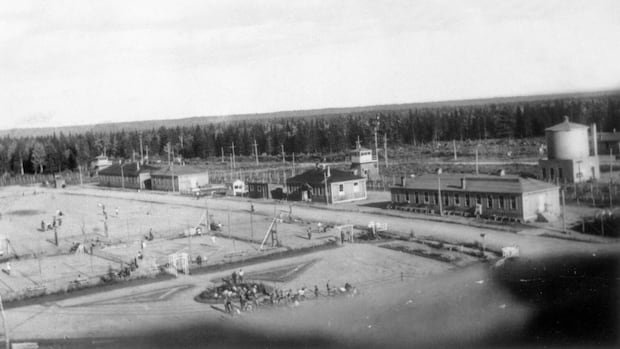
Driving east from Fredericton along Route 10 during the autumn season offers a picturesque display of vibrant fall foliage, with little else to distract your attention. However, as you approach Ripples, just southwest of the Minto area of Grand Lake, you will encounter a peculiar concrete structure alongside a couple of signs. One of the signs prominently displays the words “Internment Camp B70.”
This structure, once a water tower, is a remnant of a 24-hectare camp that confined numerous European refugees and prisoners of war during the Second World War. This camp, unique in the Maritimes, remains a lesser-known chapter in the history of New Brunswick.
Recently, a group of law and history students from the University of New Brunswick, led by their professors, embarked on a visit to the former internment camp. This trip was part of a collaborative project with the university’s Gregg Centre, which focuses on the study of war and its societal repercussions.
David Matyas, a professor overseeing the project, emphasized the significance of exploring the camp’s history in understanding the practical application of international humanitarian law. He stressed that such historical sites in one’s local community bring the study of these laws closer to home.
The internment camp, designated as B70, functioned as a secure facility enclosed by barbed wire fencing, guard towers, and bright floodlights. Initially housing European Jewish refugees fleeing Nazi Germany, the camp later accommodated German and Italian detainees from 1941 to 1945. These individuals included merchants and even Canadian citizens who opposed the war effort.
One notable internee, Henry Kreisel, documented his experiences through a diary while at the camp. Kreisel, originally from Austria, found himself at B70 after fleeing his homeland. His diary, now a valuable historical artifact, provides insights into the daily lives and struggles of the individuals confined within the camp.
The group of students, accompanied by professors, explored the wooded area surrounding the camp, immersing themselves in Kreisel’s accounts and reflecting on the hardships faced by those held in captivity. The visit culminated in a tour of the New Brunswick Internment Camp Museum in Minto, where a vast collection of artifacts, ranging from internee-made artworks to personal care items, offers a glimpse into the daily realities of life at the camp.
Neil Waldshutz, a third-year history student, expressed fascination with the museum’s artifacts, emphasizing the importance of understanding the internees’ perspective and hardships. Reflecting on the lives disrupted by war and imprisonment, Waldshutz acknowledged the resilience and struggles of those who sought freedom only to find themselves confined far from home.

