
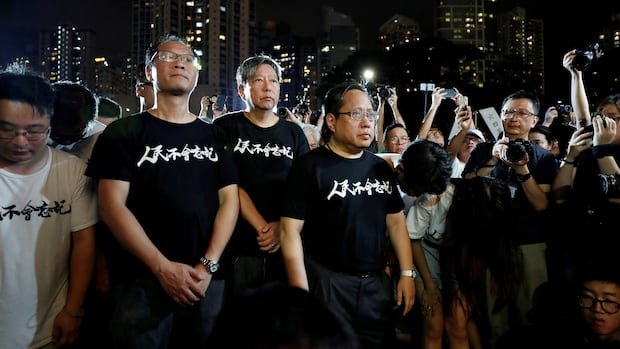
Three activists in Hong Kong, known for organizing vigils in memory of the 1989 Tiananmen Square crackdown in China, were handed prison sentences by a Hong Kong court. Lee Cheuk-yan, Chow Hang-tung, and Albert Ho were found guilty of inciting subversion earlier this year under a national security law imposed by Beijing. Lee and Chow, who pleaded not guilty, received prison terms of seven years and seven years plus three months, respectively, while Ho was sentenced to five years plus two months, a lower term due to his guilty plea.
The trio was charged in September 2021 and has been in custody for years. Hong Kong, once characterized by vibrant civil society and significant protests, saw a decline in public freedoms following a 2019 protest movement. This led to a reduction in public participation in elections and the prosecution of news outlet leaders critical of the government. Many activists have been imprisoned under the security law, with several civil society groups disbanding, including the alliance.
The sentencing of the Tiananmen activists marks the latest high-profile penalties under the security law. In February, former pro-democracy media tycoon Jimmy Lai was sentenced to 20 years in prison. Following the sentencing, Lee’s wife, Elizabeth Tang, expressed plans to appeal, highlighting the lack of freedom of speech in Hong Kong and the widespread shock and anger over the sentences.
Chow’s mother, Medina Chow Lau Wah-chun, appreciated the prosecution for recording the truth of the events related to the 1989 crackdown. Chow’s friend Lau Ka-yee mentioned that Chow would also appeal, emphasizing that pursuing democracy should not be considered a crime. The court, comprising three government-approved judges, stated that the defendants had committed a serious offense by advocating to “end one-party dictatorship,” which was deemed a threat to national security. The judges emphasized that the case did not involve violence but occurred in a turbulent social environment, posing risks to national security. They clarified that the trial was not based on the defendants’ political beliefs.

