
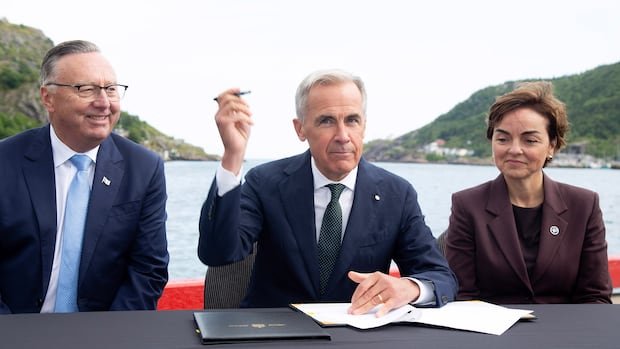
Newfoundland and Labrador Premier Tony Wakeham has decided not to hold a public vote on a new Churchill Falls deal, citing political reasons. Despite his previous pledge during the provincial election campaign to have a referendum on any Churchill Falls agreement, Wakeham, together with Prime Minister Mark Carney and Quebec Premier Christine Fréchette, unveiled a new deal that will not undergo a referendum. Wakeham acknowledged that people might be disappointed by this decision.
Explaining the shift in stance, Wakeham emphasized the significant opportunity presented by the involvement of the federal government, a development not previously considered. He highlighted changing circumstances, including the impact of the U.S. trade war and the threat of additional tariffs from President Donald Trump.
The House of Assembly is set to convene on September 14 for a special debate on the new deal. Wakeham assured that Members of the House will have the necessary resources to scrutinize the details, with the negotiating team in attendance. The revised agreement supersedes a 2024 memorandum of understanding (MOU) from the previous Liberal government, which was deemed unfavorable for the province following a review commissioned by Wakeham’s administration.
The new deal offers Newfoundland and Labrador the option to sell power to Quebec or use excess power to support local industries. Ottawa’s involvement brings added benefits, such as loan guarantees for the Gull Island hydroelectric project, investment tax credits, and assistance in constructing the Labrador Transmission Line. Wakeham estimated over $3.5 billion in federal investments, positioning the government as a partner in the endeavor.
Despite the upcoming Quebec election potentially bringing a new administration to power, Wakeham expressed confidence in the agreement’s mutual benefits for both provinces. He aims to finalize the agreement by year-end.
Charlene Johnson, CEO of Energy N.L., expressed pride in the natural resources available in Newfoundland and Labrador, emphasizing the potential for extensive employment opportunities across various phases of the energy projects. Johnson echoed Carney’s description of the deal as the largest clean energy investment in North American history, underscoring the region’s capacity to meet global energy demands amidst geopolitical uncertainties.

