
U.S. President Donald Trump expressed his support for the unification of British-run Northern Ireland with Ireland during his visit to Dublin, causing a stir among pro-British unionists in Northern Ireland. Trump’s remarks contrast with British Prime Minister Andy Burnham’s recent statement that a referendum on Northern Ireland’s exit from the United Kingdom was not under consideration, a stance upheld by Downing Street.
Speaking alongside Irish Prime Minister Micheál Martin in Dublin, Trump stated his wish for a unified Ireland, emphasizing that he believed it would be a positive development in the future. While acknowledging the U.K.’s involvement in the matter, he reiterated his enthusiasm for the idea. Trump acknowledged the complexities surrounding Irish unity but maintained his view that it could be a positive development.
Trump’s departure from the neutral stance typically adopted by previous U.S. presidents on Irish unification reflects a significant shift. The 1998 Good Friday Agreement, brokered with the involvement of former U.S. President Bill Clinton, outlines that any referendum on Irish unity must be authorized by the British government.
The historical backdrop of three decades of conflict between Irish nationalists and unionists in Northern Ireland underscores the sensitivity of the issue. Despite polls indicating a majority preference for remaining within the U.K., the topic of Irish unity has gained traction following the U.K.’s withdrawal from the European Union.
Northern Ireland’s largest pro-union party, the Democratic Unionist Party, dismissed Trump’s remarks, emphasizing that the region’s future should be determined by its residents rather than external commentary. In response to Trump’s prediction, the party’s leader Gavin Robinson underscored the importance of local decision-making in shaping Northern Ireland’s destiny.
Supporters of Irish unity in Belfast cautiously responded to Trump’s statement, viewing it as attention-seeking rather than a genuine commitment to the cause. Past U.S. presidents, such as Joe Biden, known for their Irish heritage, have maintained a neutral stance on the issue, with the U.S. playing a pivotal role in securing peace in the region through diplomatic efforts.
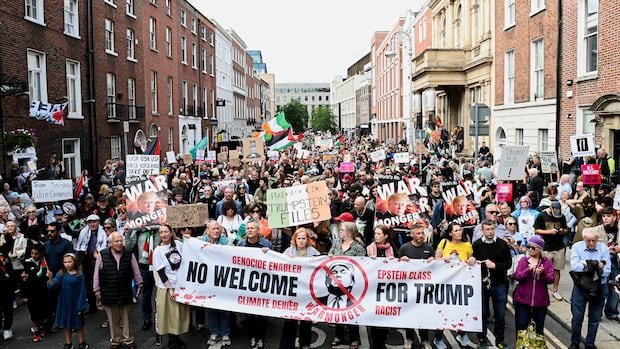
Following Trump’s departure to attend a golf event at his Irish resort, protesters in Dublin staged a large anti-war demonstration, criticizing the president’s policies and actions. The protest, marked by slogans denouncing Trump as a warmonger and advocating for Palestinian rights, underscored the contentious nature of Trump’s visit to Ireland.
Overall, Trump’s remarks on Irish unity have sparked debate and drawn attention to the complex historical and political dynamics at play in the region.

