
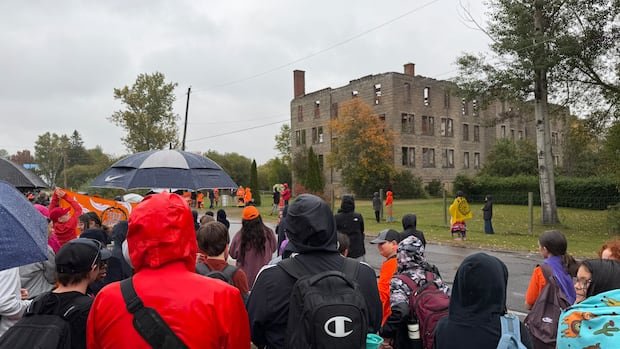
On the National Day for Truth and Reconciliation, Alyssa Traves strolled near the old Spanish Indian Residential School with a smudge pot in hand. Across the road, she observed numerous school children visiting the historic site, standing solemnly in the rain. Traves, the project manager for the Spanish residential school, described the experience as profoundly moving, witnessing young children embrace their identity with pride, whether as allies or Indigenous individuals. She emphasized the significance of their presence at the site.
Despite the rainy weather, the recent gathering served as a preliminary event for Traves’ vision for the old school site in Spanish, situated on the northern shore of Lake Huron in Ontario. Operational between 1913 and 1965, the Spanish school complex welcomed hundreds of Indigenous children from 44 communities across Canada. While most structures have been demolished, the four-story stone remnants of the “girl’s school” remain on private property.
Traves, a member of the Serpent River First Nation, is in the initial planning stages to attract more visitors to Spanish, aiming to educate them about the residential school’s legacy. Utilizing advanced technology, they are digitally reconstructing the school complex to offer online tours, showcasing photos, survivor stories, and gradually unfolding the narrative. Traves also proposes installing signage with QR codes on-site for visitors, including passing motorists and school groups, to immerse themselves in the students’ historical footsteps.
Moreover, discussions are underway with the Jesuits, the Catholic order overseeing the Spanish boys’ school, to explore their role in narrating the story in the future. A key consideration moving forward is the fate of the old girls’ school ruins. Recently, with the property owner’s consent, visitors had a rare opportunity to explore the fire-damaged institutional structure.
Reflecting on the visit, local resident Brittany Laurin expressed mixed emotions of sadness and anger towards the site’s history, acknowledging its historical significance. Verna Simpson, aged 77 and hailing from Serpent River, visited to commemorate her late sister Patricia, who attended the school in the 1940s but never spoke of her experiences. Simpson advocates for preserving the building as a reminder of the past atrocities.
Another attendee, Jeannette Commanda, now 85, shared her personal experience as a former student at the Spanish residential school. Originally from Birch Island, she spent her teenage years there before being retrieved by her grandfather. Commanda emphasized the importance of educating future generations about the school’s dark history rather than solely preserving the physical structure. She emphasized the need to appreciate the present compared to the hardships endured by former students.
Traves emphasized the forthcoming steps in her initiative, focusing on reinstating various aspects of the site and pursuing heritage status for the former school building to preserve it as a monument. Stressing the importance of maintaining a visual reminder of the past, she acknowledged the diverse perspectives of survivors. Traves highlighted the absence of a clear roadmap for this endeavor but stressed the necessity of not overlooking the school’s legacy.

