
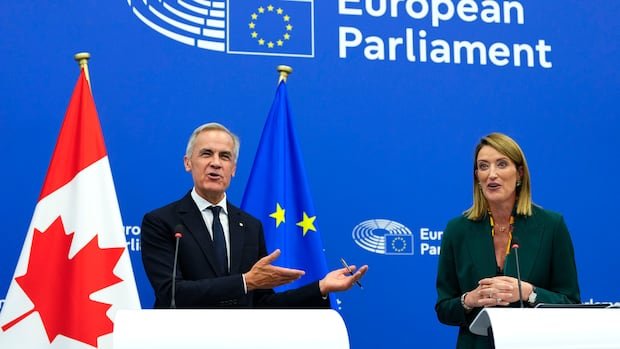
Canada and the European Union are moving towards closer collaboration, with Prime Minister Mark Carney expressing interest in Canada joining the popular European exchange program, Erasmus+. During a speech at the European Parliament in Strasbourg, France, Carney advocated for Canadian participation in Erasmus+ to enhance educational opportunities for students from both regions and foster long-term alliances.
While the specifics of this potential partnership, such as Canada becoming the EU’s first “associate member,” are still being worked out, Carney clarified that Canada is not pursuing full EU membership and that a distinct framework would be needed for this collaboration. He also indicated Canada’s interest in participating in the upcoming Horizon program, Europe’s research and innovation funding initiative, which already involves Canada. The current Horizon program for 2021-2027 has a funding allocation exceeding $140 billion.
European Parliament President Roberta Metsola expressed optimism about the prospects of enhanced collaboration with Canada, emphasizing the significance of Erasmus and Horizon in facilitating opportunities for youth from both regions to study, work, and learn from each other. Carney highlighted the potential benefits of cross-border education and cultural exchange between Europe and Canada.
Although the specifics of Canada’s involvement in Erasmus+ are yet to be determined, the recent agreement by the United Kingdom to join the program on a temporary basis could serve as a model for Canada’s participation. The UK’s temporary agreement with Erasmus+ includes a contribution of 570 million pounds for the year 2027.
Erasmus, established in 1987 and later expanded into Erasmus+, allows individuals to study and train across European institutions, encompassing university exchanges, work placements, apprenticeships, and sporting initiatives. Over 16 million individuals have participated in the program since its inception, with the EU channeling significant funding into the initiative. The Erasmus+ program, which operates from 2014 to 2020, received substantial financial backing from the EU and has expanded its scope to include various initiatives and areas of focus.
The program’s funding has seen a significant increase for the 2021-2027 period, highlighting the EU’s commitment to supporting learning mobility and fostering cooperation among participating nations. Erasmus+ encompasses all 27 EU member states, alongside countries like Norway, Iceland, Liechtenstein, Serbia, Turkey, North Macedonia, and the UK.

