
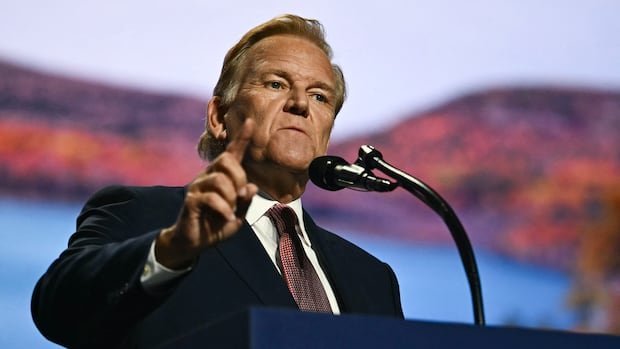
The Republican contender vying for Michigan’s vacant Senate position is urging U.S. President Donald Trump to halt the trade conflict with Canada. Mike Rogers has unveiled a new 30-second commercial denouncing the tariffs while seated in a sports bar with a Labatt beer, a Canadian brand popular in border states like his. Rogers stresses in the ad that Canada is not an adversary to Michigan and emphasizes the need to cease the tariff dispute promptly. He pledges in the advertisement to unite both political parties to reduce prices for the citizens as a top priority.
During a press briefing in the Oval Office later on Wednesday, President Trump shrugged off the advertisement, interpreting Rogers’s stance on the trade war differently. Trump asserted that he perceived it as an appeal for Canada to negotiate a deal, reiterating his belief that Canada has been taking advantage of the U.S. for many years and emphasizing that the current situation needed to change.
This marks a significant shift for Rogers, who had previously endorsed the tariffs imposed by Trump on Canadian products. In an interview with Fox News earlier this summer, Rogers commended Trump’s trade strategy aimed at revitalizing U.S. industries, describing it as highly beneficial. He criticized Canada’s desire to sell a large number of cars in Michigan, deeming it unacceptable as it undermines local automobile manufacturing and workers. Rogers expressed disappointment with Canada’s lack of cooperation on this matter.
Rogers, who has a close association with Trump, is trailing behind his Democratic rival, Abdul El-Sayed, in various public opinion polls. Following the release of the ad, El-Sayed criticized Rogers, accusing him of inconsistency due to dwindling poll numbers. El-Sayed blamed Trump for instigating the trade war and Rogers for opportunistically changing his stance.
Polls indicate that Trump’s tariffs are unpopular among Americans, with only 26% supporting the imposition of tariffs on Canadian goods, according to a recent Politico survey. The deep integration of the Canadian and U.S. auto sectors highlights the intertwined nature of their manufacturing relationship, with Canada supplying crucial parts used in U.S. assembly plants. This interdependence has fostered competitiveness in the North American auto market against overseas manufacturers.
Despite claims by Republicans that Trump’s tariff policies are enhancing industrial employment, data compiled by the U.S. Bureau of Labor Statistics and the Economic Policy Institute reveal a loss of approximately 62,000 manufacturing jobs since Trump’s second term began in January 2025. Ford, headquartered in Dearborn, Michigan, continues to dominate the Canadian vehicle market, with its American-made F-Series trucks being particularly popular among Canadian consumers.

