
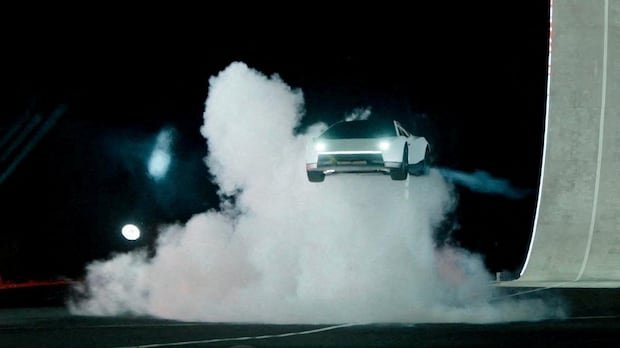
Tesla has introduced a revamped Roadster equipped with rocket-style thrusters, announcing plans to commence production in 2028, over ten years after revealing a new version of its electric sports car. The two-seater vehicle, created in partnership with SpaceX, Elon Musk’s rocket firm, showcased unique capabilities such as driving upside down on a ramp using a suction system, performing mid-air turns, and landing with built-in thrusters. At the event, the Roadster demonstrated its agility by leaping over a truck and other vehicles, impressing onlookers. Some observers viewed this collaboration as a strategic move by Musk to generate interest in a potential merger between Tesla and SpaceX.
Following the unveiling, Tesla’s stock surged by five percent in pre-market trading on Friday. Despite the Roadster’s delayed release, the reveal serves as a flagship model for Tesla, aligning with the company’s evolving focus on self-driving technology and robotics. The event occurred shortly before the anticipated third-quarter financial results, crucial for investor evaluation.
Gene Munster, managing partner at Deepwater Asset Management and a Tesla investor, described the Roadster launch as a show of engineering prowess rather than a significant financial move for Tesla. Musk himself has downplayed the car’s financial impact in previous statements. However, the Roadster holds symbolic significance for Tesla, filling the void of a high-performance luxury vehicle that showcases the automaker’s technological prowess.
With no specific pricing details provided at the event, Tesla’s reservation page displayed varying deposit amounts for different versions of the Roadster, ranging from $50,000 to $250,000. The event, held at a SpaceX testing location in Texas, featured typical Musk-style theatrics, including dramatic music, smoke effects, and a grand launch countdown, underscoring the collaborative efforts of Tesla and SpaceX engineers.
The Roadster boasts impressive performance metrics, accelerating from zero to 97 km/h in under a second and reaching speeds exceeding 370 km/h, according to Tesla’s vehicle engineering chief. Musk, exuding excitement, hinted at even faster speeds, emphasizing the vehicle’s groundbreaking capabilities. Despite falling short of past promises on range, the Roadster can still travel over 480 kilometers on a single charge.
Originally launched in 2008, the Roadster marked Tesla’s entry into the electric vehicle market, setting the stage for its subsequent models like the Model Y, Model X, Model S, and Model 3. The latest Roadster unveiling coincides with Tesla’s strategic pivot towards AI-driven self-driving technology and robotics, reflected in recent product developments such as the Optimus humanoid robot and the Cybercab robotaxi.
As Tesla gears up to release its third-quarter results on October 21, analysts anticipate a focus on financial metrics amid declining sales of its existing EV lineup. The company’s strategic shift towards cutting-edge technology indicates a broader transformation beyond traditional automotive manufacturing, emphasizing innovation in AI and robotics over conventional vehicle production.

