
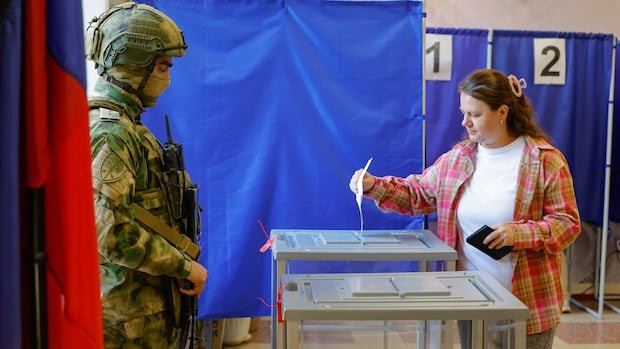
Russians kicked off a three-day voting period on Friday for the nation’s first parliamentary election during wartime. The election is expected to solidify the Kremlin’s political control with minimal opposition. The voting process was extended over the weekend to encourage participation among the 111 million eligible voters, including the option for electronic voting. Polling stations opened on Friday and will conclude on Sunday.
The Kremlin aims to use the parliamentary election, the first since the full-scale invasion of Ukraine in 2022, as a means to showcase public backing for the war and to legitimize its actions. Authorities have actively suppressed any form of dissent to mitigate political risks. Russian President Vladimir Putin emphasized the significance of citizens’ choices in demonstrating unity and support for the country’s actions.
Russian state media reported that Putin cast his vote online on Friday, underscoring his participation in the electoral process. The dominant political party, United Russia, is poised to maintain its stronghold in the State Duma, the lower house, with other compliant parties of the “systemic opposition” expected to retain their influence.
Notably, this election includes residents from four Ukrainian regions annexed by Moscow post-war commencement, as well as voting in Crimea, annexed by Russia in 2014. Despite objections from Kyiv, labeling the voting in Russian-controlled territories as illegal, the European Union has also denounced the election as a violation of international law and has refused to recognize its validity.
Furthermore, anti-war sentiments have been stifled leading up to the election, with limited opposition voices present on the ballot. The Yabloko party, known for its criticism of the war, was barred from participation by Russia’s Supreme Court. Some anti-war figures have faced imprisonment or exile ahead of the election.
As voting continues, Russians have expressed varied hopes and concerns. Pensioner Galina Vavilova emphasized the importance of ending the conflict in Ukraine for the safety of the nation’s citizens, while fellow pensioner Lyudmila Kalinina expressed desires for societal stability and reduced inequality. The election follows a period of economic challenges stemming from Ukraine’s drone strikes, impacting the Russian economy and daily life for many.
Overall, the parliamentary election in Russia unfolds against the backdrop of ongoing geopolitical tensions and internal political dynamics, shaping the country’s trajectory in the midst of war and international scrutiny.

