
In the lobby of a towering building on Fifth Avenue, under a ceiling that seemed to have a scheduled tanning session, I observed a reality TV personality making a grand entrance into the realm of American politics.
Back in June 2015, few fully grasped the significance of Donald Trump’s emergence. It wasn’t just a show; it was a strategic move calculated to unveil a dangerous agenda. With his bid for the presidency, he portrayed migrants as criminals and painted grievances as acts of patriotism. The scene felt like a scripted drama, almost surreal, with the host of “The Apprentice” transitioning seamlessly into a presidential campaign.
This wasn’t mere theatrics; it was the beginning of a political offensive crafted around division, fueled by spectacle, and aimed at perpetuating a state of constant confrontation. The repercussions of Trump’s actions continue to reverberate globally, even reaching places like South East Manchester.
Since that pivotal day, Trump has honed a playbook that has reshaped modern populism. He positioned himself as the advocate for the overlooked “forgotten” Americans, while vilifying courts, journalists, and civil servants as corrupt adversaries. His narrative framed a battle between “the people” and an elite class. Immigration transformed from a policy issue into a cultural battleground, with a border wall symbolizing strength and deportations serving as badges of authority.
While promising to uplift working families, Trump’s major legislative accomplishments have disproportionately favored corporations and the affluent. His billionaire associates have flourished, some even evading justice, while many workers struggle to keep up with escalating living costs, if they are fortunate enough to retain their jobs.
Concurrently, trade conflicts were initiated in the name of safeguarding domestic industries, tariffs imposed, and international alliances strained under the banner of “America First.” Any setbacks were attributed to external forces, and critics were labeled as saboteurs. Even judges, including Supreme Court justices, faced attacks. Loyalty superseded expertise, and division was not just a byproduct but the core principle driving the administration’s agenda.
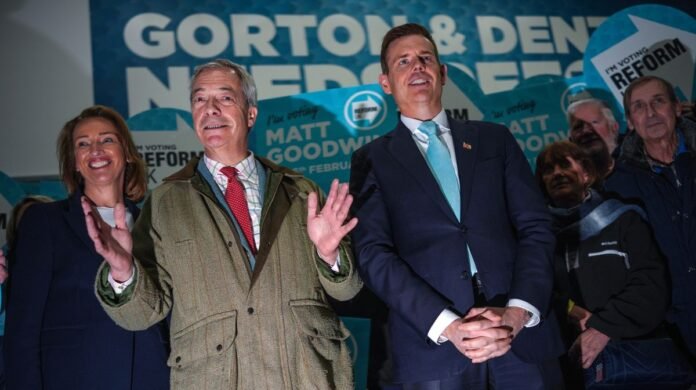
This trend should serve as a warning for voters in Gorton and Denton. Their choices at the polls extend beyond party affiliations; they are essentially deciding whether to embrace a similar style of politics rooted in grievances, confrontation, and personalities.
The parallels between Trump’s tactics and the strategies endorsed by Nigel Farage and Reform UK are hard to overlook. Farage, a self-proclaimed admirer of the US president, has emulated Trump’s rhetoric and approach. His team, including individuals like Zia Yusuf and Richard Tice, echoes the combative style favored by Farage. This shift in tone and alignment signifies not just a movement of individuals but also a migration of political discourse.
What binds them is not detailed policy proposals but the allure of political opportunities, the promise of the next spotlight, and the next step up the ladder. The resemblances in their methodologies are glaring.
Farage, a fervent admirer of Trump, has cultivated an outsider image – a plain-speaking insurgent railing against the establishment elites. Just as Trump framed Brexit as a battle for sovereignty against distant bureaucrats, Farage’s rhetoric revolves around betrayal and restoration, central to his political persona.
Now, immigration has taken center stage in Reform UK’s messaging, mirroring Trump’s emphasis on the issue. Calls for stringent migration controls, fortified borders, and disengagement from international agreements are pitched as straightforward solutions to complex challenges. In both scenarios, immigration transcends mere policy to become a symbol of national resolve.
Another common theme is national sovereignty. Trump’s “America First” doctrine prioritized domestic authority over international collaborations, while Farage’s platform focuses on reclaiming sovereignty from European counterparts. Both express disdain for global institutions, arguing that these structures disadvantage ordinary citizens.
On the economic front, the similarities deepen. Trump advocated for reduced corporate taxes and deregulation, favoring the affluent, a stance echoed by Reform UK. Both portray smaller government as a gateway to freedom, benefiting from financial support tied to wealth.
Their energy policies also align, with Trump promoting fossil fuel expansion and scrapping environmental protections, while Farage and his associates criticize net-zero objectives and environmental levies, contending that green initiatives burden households.
However, the most pressing concern is not policy alignment but rather the tone set by these leaders. Trump mastered the art of provocation, turning controversy into a political asset, while Farage capitalized on headline-grabbing rhetoric and insurgent posturing. In their worlds, personality eclipses policy, and loyalty overrides details.
Reflecting on the US experience, this confrontational approach has left a legacy of deep polarization. While early rallies were energizing and slogans resonated, over time, trust in institutions waned, communities hardened, and economic policies favored the affluent.
Although America remains divided, the United Kingdom’s political structure differs, with distinct constitutional traditions. Nonetheless, the political landscape can shift when divisive language normalizes discord and anger becomes the prevailing principle.
For voters in Gorton and Dent

