
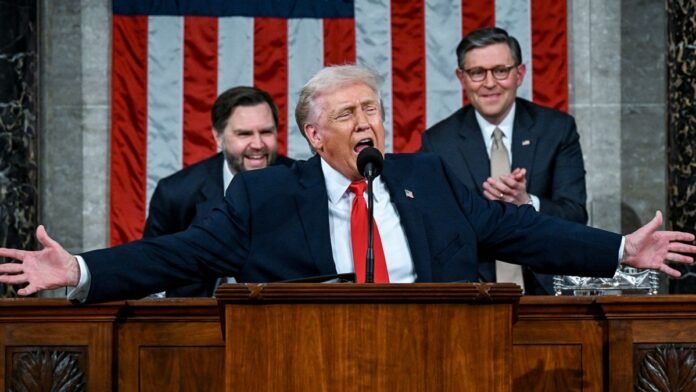
In what should have been a reflection of the nation’s current state, Donald Trump’s State of the Union address resembled a contentious debate with a medical scan rather than a health assessment. Throughout the lengthy speech, the US president reshaped reality to suit his narrative, disregarding facts and context. While self-praise flowed abundantly, disconnected from the reality faced by most Americans, the speech divided the chamber into two sharply opposing factions.
Republicans eagerly applauded, reminiscent of a Jerry Springer audience anticipating drama, while Democrats appeared frozen in disbelief, unsure how to react. The address unfolded more like a repetitive routine, featuring a compilation of MAGA’s greatest hits in an extended format. It was laden with theatrics, emotional manipulation, and gratuitous distribution of medals akin to party favors at a toddler’s birthday celebration.
The event showcased a parade of guests for applause, exploited tragedies for acclaim, and appropriated heroism for temporary glorification. Trump appropriated others’ stories, basking in their valor as if it were his own. Notably, the boundaries blurred between honoring heroes and self-aggrandizement, exemplified when Trump, a draft dodger, pondered receiving top national awards.
Despite Trump’s confident delivery of falsehoods, the speech contradicted reality on multiple fronts. Economic claims about the nation’s prosperity, safety, and strength clashed with prevailing hardships like stagnant wages, ailing healthcare, and strained international relationships. Dark undertones emerged, including veiled racism, fearmongering regarding immigrants, and baseless voter fraud allegations fostering a severe voter suppression agenda.
The address lacked dynamism, resembling a loyalty pledge rather than a democratic tradition. Trump’s disdain for checks and balances, evident in the applause from a segment of Congress, underscored a troubling disregard for institutional oversight. The spectacle, though broadcast extensively, failed to engage viewers beyond its superficial showmanship.
Trump’s dwindling public approval, unpopularity of major policies, and waning enthusiasm even among his core supporters suggest that the address did little to alter his declining standing. Instead of revitalization, the speech epitomized a presidency entrenched in past grievances, falsehoods, and theatricality masquerading as governance. It portrayed a superpower disconnected from reality, reflecting the state of the man behind the delivery.
The event symbolized a nation at an impasse, as the rest of the world quietly recalibrates in response to a performance marked by detachment from veracity and an alarming disconnect from reality. Trump’s address epitomized a state of mind characterized by delusion, hysteria, and a disconcerting detachment from the actual state of the union.

