
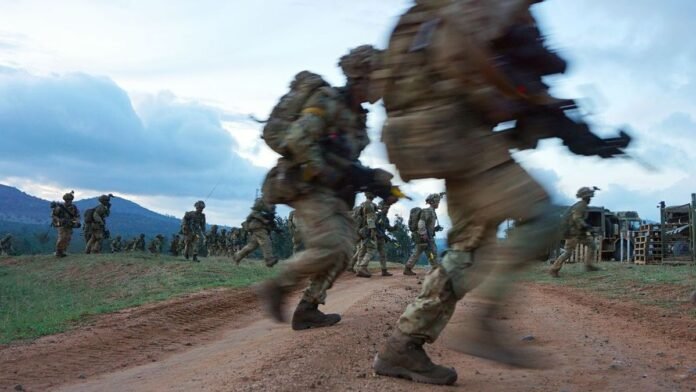
The emergence of ‘gap year soldiers’ being prepared for combat in conflict zones has sparked discussions on potential conscription in the UK in 2026. An expert’s predictions shed light on what this may entail.
Scheduled to launch in March 2026, individuals under 25 will have the opportunity to enroll in a new gap year military program aimed at bolstering army recruitment and enhancing young people’s life skills amidst growing concerns over Russian threats. Inspired by a similar initiative in Australia, the scheme will commence with a modest group of 150 participants, with aspirations to expand to over 1,000 annually.
Participants will be exposed to military life and receive transferable skills, even if they choose not to pursue a full-time military career. While there is no mandatory commitment, those opting to continue with the Armed Forces can access additional training for potential deployment in operations.
Recent developments include Russia’s rejection of a peace deal in Ukraine and alarming threats towards British soldiers, including labeling them as “legitimate military targets.” This has prompted collaborative efforts from UK Prime Minister Keir Starmer and French President Emmanuel Macron to establish military ‘hubs’ in Ukraine for defensive purposes, a move met with resistance from the Kremlin.
The upcoming gap year initiative, as discussed by experts like Professor Anthony Glees, emphasizes the importance of national conscription in addressing contemporary security challenges. Despite the absence of conscription references in the National Security Strategy report, Professor Glees advocates for expanding the armed forces through conscription as a cost-effective means of countering real threats.
While National Service has been a contentious topic for decades, successive governments have dismissed military conscription, favoring voluntary recruitment. However, with evolving global security dynamics, some argue that National Service has become indispensable.
Professor Glees advocates for conscription for national service, emphasizing the significance of a well-trained UK land army in deterring threats. The proposed gap year program aims to offer young people valuable experiences and training within the Armed Forces, fostering a deeper connection between society and defense efforts.
In light of the escalating cost-of-living crisis, incentives such as cheap loans for mortgages and free university education are proposed to encourage young individuals to engage in national service. The program is envisioned as an attractive employment opportunity for school leavers and young adults seeking career direction or skill development outside the military.
As discussions on nuclear warfare intensify, Professor Glees asserts that future conflicts in Europe are likely to rely on conventional means rather than nuclear weapons. He underscores the importance of a robust land army in safeguarding national security, emphasizing the need to reevaluate defense strategies to protect borders effectively.
The new Army scheme is set to span two years, starting with a 13-week basic training course followed by specialized training in specific areas. The Navy and RAF are also exploring gap year schemes tailored to provide valuable skills and experiences for young recruits.
Historically, conscription has played a vital role in military recruitment during significant global conflicts, such as World War I and World War II. While mandatory enlistment ceased after the 1960s, the armed forces have transitioned to a professional volunteer-based structure, welcoming women into all military roles since 2018.
The legacy of conscription in Britain serves as a reminder of the collective sacrifices made during times of conflict. As the nation navigates evolving security challenges, discussions on national service and conscription continue to shape defense strategies and recruitment approaches to address contemporary threats.

