
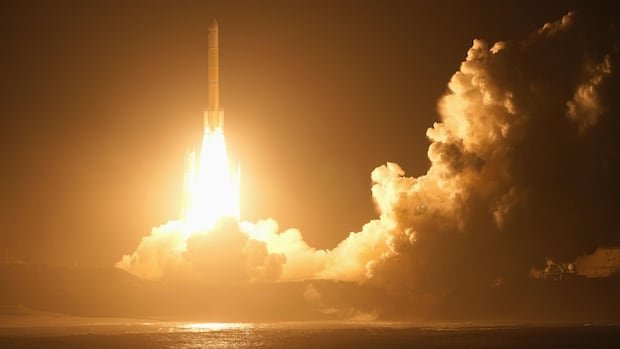
A spacecraft from Japan was launched on a mission to Mars with the goal of exploring its enigmatic moons and collecting samples. This unprecedented five-year endeavor involved collaboration between five global space agencies to land a robotic prospector and rover on Phobos, one of Mars’s two small moons.
The Japan Aerospace Exploration Agency spearheaded this ambitious project, successfully launching the spacecraft from Tanegashima Island’s main spaceport. The spacecraft separated from the rocket’s upper stage as planned, marking a significant achievement for the mission. While past missions have landed on Mars, including China’s recent touchdown, no previous mission has ventured to Phobos or its companion moon, Deimos, let alone collected samples.
If the mission is successful, samples of dust, soil, and rocks from Phobos are expected to return to Earth in 2031. This mission, known as Martian Moons Exploration (MMX), aims to study Phobos, a small, irregularly shaped moon, to gain insights into the formation of Mars’s moons and potentially moons in other planetary systems.
The spacecraft, carrying a French-German rover named Idefix, is scheduled to reach Mars by the end of next summer. Idefix, designed to self-right upon landing, will explore Phobos for 100 days to assess the terrain and ensure safe conditions for the main lander to collect samples in late 2028 or 2029.
The lander will spend a brief two hours on Phobos, collecting at least 10 grams of material before departing to study Deimos and return to Earth in 2031. The mission’s success could provide crucial insights into planetary and moon formation, shedding light on the possibility of past life on Mars.
This mission represents a significant investment, with Japan committing $350 million, NASA contributing $122 million, the French Space Agency providing about $95 million, the German Space Agency around $79 million, and the European Space Agency contributing approximately $24 million. As Japan and China race to retrieve samples from the Martian system by 2031, the scientific community eagerly anticipates the discoveries that await from this groundbreaking expedition.

