
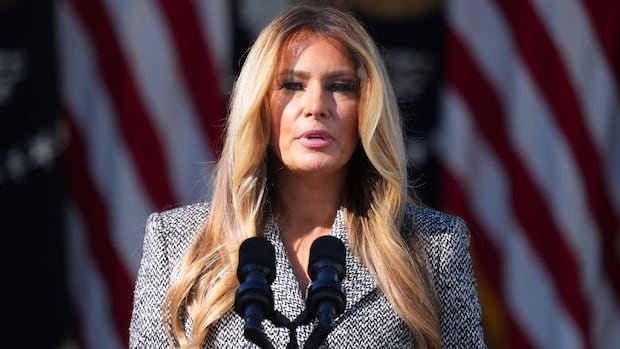
Melania Trump has brokered a temporary truce between Russia and Ukraine in the Russian-held town of Oleshky, set to commence on October 29, as announced by the White House on Friday.
Residents of Oleshky, a town in southern Ukraine under Russian occupation since February 2022, have raised concerns about a worsening food shortage.
A statement from the White House revealed that both countries have agreed to a cessation of military activities in Oleshky to facilitate the delivery of humanitarian aid and organize the safe evacuation of civilians through designated routes. Melania Trump and her representative collaborated directly with Russian and Ukrainian authorities to outline the conditions of the localized ceasefire.
Describing the critical situation in Oleshky, Melania Trump emphasized the city’s urgent need for medical assistance, medication, sustenance, and clean water, especially for its elderly population. The ceasefire will enable non-military teams from both nations to visit residents at their homes and arrange transport for those opting to evacuate to either Russia or Ukraine.
The Kremlin disclosed that the evacuation process in Oleshky could take several days and commended Melania Trump for her efforts, mentioning that the matter was discussed during a recent conversation between her husband and Russian President Vladimir Putin.
Following U.S. President Donald Trump’s return to the White House early last year, Melania Trump has actively campaigned for the return of Ukrainian children taken by Russia during the conflict to their families.
Oleshky, situated across the Dnipro River from Kherson, now houses a population of around 1,700 to 2,000 individuals, predominantly elderly residents with approximately 50 children, a stark decrease from the pre-war population of roughly 24,000. The White House noted that nearly 90% of the city was submerged due to the destruction of the Kakhovka Dam.
In recent developments, the White House faced criticism for its involvement in the five-year-long conflict, particularly from Ukraine’s European allies, Democrats, and some Republicans. President Trump initially reached an agreement with Putin to import diesel and pressured Kyiv to cease attacks on Russian energy infrastructure, attributing them to diesel price hikes.
Subsequently, a ceasefire on energy assaults was unilaterally declared by Trump after Ukraine expressed openness to the idea, although Russia showed no willingness to halt its attacks. Ukrainian President Volodymyr Zelenskyy then reported restrictions imposed by Elon Musk’s SpaceX on Starlink services, affecting Ukraine’s ability to counter Russian threats.
Trump and Musk, alongside U.S. Secretary of State Marco Rubio, provided varying accounts of the events surrounding the throttling of Starlink services, with Trump asserting that the issue was resolved eventually. Tensions between Trump and Zelenskyy have persisted since Trump’s impeachment in 2019, with past disagreements over military assistance to Kyiv.
In recent combat activities, Moscow’s Sheremetyevo Airport resumed operations after a brief suspension due to a Ukrainian drone alert, with Moscow Mayor Sergei Sobyanin reporting the downing of 21 Ukrainian drones en route to the Russian capital.
Moreover, the conflicting parties engaged in a mutual exchange of prisoners, with 270 individuals from each side being repatriated. Ukrainian officials confirmed the repatriation of bodies and individuals killed in the war, with over 19,000 Ukrainian civilians, including 762 children, having lost their lives since the start of Russia’s extensive military campaign in the region.
Ukrainian prosecutors reported that in 2026 alone, 2,960 civilians, including 668 children, fell victim to the ongoing conflict.

