
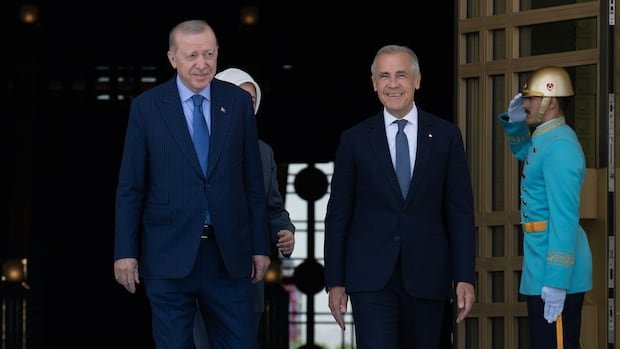
Prime Minister Mark Carney is set to embark on a three-day trip to Turkey on Wednesday to engage with a key NATO ally, which has increasingly become attractive to Ottawa in terms of economic and defense industries.
During his visit, Carney will hold meetings with President Recep Tayyip Erdoğan in Ankara and business leaders in Istanbul. This visit marks the first dedicated bilateral trip to Turkey by a Canadian prime minister.
The discussions signal a positive shift in relations between the two countries following Canada’s previous imposition of a de facto arms embargo. This action was taken after allegations surfaced in 2021 that Ankara had redirected Canadian-manufactured drone parts to Azerbaijani forces during the conflict with Armenia over Nagorno-Karabakh. Subsequently, the policy has been relaxed.
The trip comes shortly after Turkish authorities initiated a widespread crackdown on dissent and civil society, with a particular focus on LGBTQ+ and HIV advocacy groups.
Senior federal officials, speaking on background ahead of the trip, emphasized that Canada’s approach to foreign policy is grounded in values-based realism. The officials highlighted the government’s commitment to fundamental values such as freedom, human rights, sustainability, and solidarity, while acknowledging that not all partners may share these values entirely.
Three key issues are expected to dominate Carney’s discussions in Turkey: negotiating a free trade agreement, expanding cooperation in energy and strategic industries, and strengthening the defense-industrial relationship.
Canada conducts approximately $4.3 billion in trade with Turkey, and the launch of free trade negotiations was officially announced by Carney and Erdoğan during the NATO summit in Ankara. The prime minister aims to establish a closer strategic partnership with Turkey as part of Canada’s efforts to diversify its international economic ties and reduce reliance on the United States.
Accompanying Carney on the trip will be Foreign Minister Anita Anand and Energy Minister Tim Hodgeson.
One significant area of interest is Canada’s proposal to engage Turkey in discussions related to Candu nuclear reactors, as Turkey seeks to expand its nuclear energy sector. This potential collaboration underscores the long-term commitments and complexities involved in nuclear projects.
Regarding defense industrial cooperation, Canada’s Secretary of State for Defense Procurement, Stephen Fuhr, has previously described Turkey as a trusted partner and highlighted areas such as ammunition production, drones, and counter-drone systems for potential collaboration.
Despite past tensions over military exports, Canada continues to apply its export control framework diligently, ensuring that military equipment exports adhere to international humanitarian laws and regulations. The reinvigoration of dialogue with Turkey has paved the way for ongoing discussions to enhance the partnership between the two countries.

