
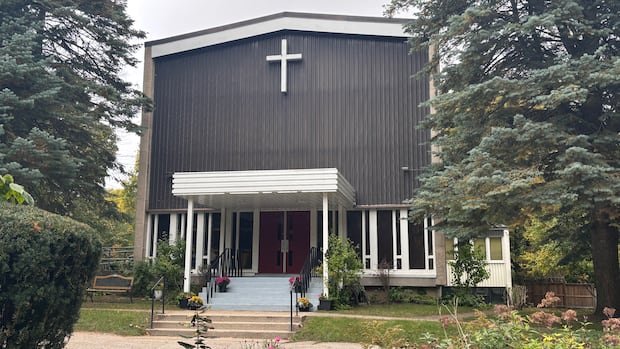
The Diocese of Huron is objecting to a recommendation by city staff to grant heritage protection to a church located in London’s Orchard Park area, citing concerns that it could limit future redevelopment possibilities for the site. According to a staff report, the Church of the Transfiguration at 33 Bromleigh Ave. fulfills five out of the province’s nine heritage criteria, surpassing the two required for heritage consideration.
Constructed in 1962, the church was designed in the Mid-century modern style by architect Philip Carter Johnson, known for his work on London’s City Hall, Centennial Hall, and other religious buildings like the B’nai Israel Synagogue (now the Or Shalom Synagogue) in the city. Noteworthy features of the church’s modernist design include a stone facade on the east and west walls with small square colored glass windows that illuminate the church nave softly.
The city report highlights the church’s distinctive paired tile mosaic entry doors, each crafted from 6,000 tile pieces depicting scenes from the Bible. Although originally installed in 1962, the doors have been relocated inside the church to protect them from the elements.
Jacqueline Davison, the acting secretary treasurer of the Anglican Diocese of Huron, has expressed opposition to designating the church as a heritage site, citing alterations such as the addition of metal siding that have detracted from its architectural value. Davison also raised concerns about increased maintenance costs and potential limitations on future development plans if heritage status is granted.
While acknowledging the church’s historical significance, former church warden Paul Webb has advocated for heritage protection to prevent unsuitable redevelopment that could disrupt the harmony with the surrounding residential area. The decision on the church’s heritage designation has been deferred to allow for further consultation with the property owner, with the vote scheduled for the December 1 meeting after the upcoming city council elections on October 26.

